
Ten Questions on a Recent Scandal
A by no means exhaustive treatment.

Preface
The following goes into the weeds of the Code of Canon Law. Those unfamiliar with the nature of canon law in the Catholic Church may benefit from the previous post “On the Origin & Uses of Canon Law.”
I do not claim a special competence with the Code and I admit this well-exceeds my proper purview. I am not a canonist.

Introduction
The recent publicly announced confirmation of a news anchor with his putative husband serving as sponsor and a prominent, Jesuit activist among the concelebrants of the Mass has fueled some scandal and confusion among Catholics and non-Catholics alike. This work aims at the provision of a clear and reasonably concise examination of several questions which arise from the case, for which I primarily turn to the 1983 Code of Canon Law of the Latin Catholic Church. In short, a number of delicts (canonical crimes) appear to have been committed, including abuse of ecclesiastical office and sacrilege, and the confirmand in question has received what is likely a valid but illicit confirmation. Barring redress, this would mean his reception of the sacrament affords him none of the graces of that sacrament.
For the ease of navigation of the reader, I suggest consulting the table of contents on the left side to select specific questions. Some answers are significantly more involved than others. Headers have been used to provide extremely concise answers to most of the questions.
Quaestiones
Question No. 1: What are the facts of the case?
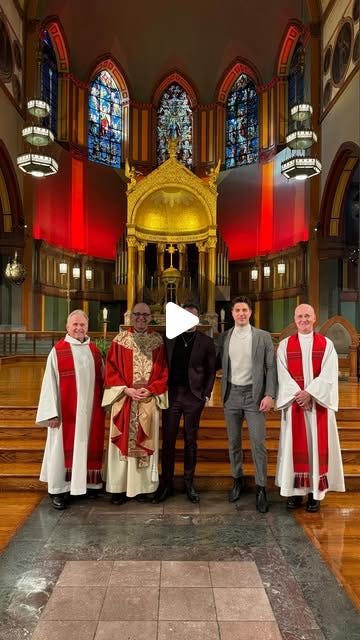
As the above Instagram post indicates, a man baptized a Catholic, in a homosexual union, was confirmed in the context of a Mass.1 Looking at the video, it seems clear that chrism oil was used, a relevant factor for the validity of the sacrament.2 I will presume for the sake of this analysis that the priest who conferred the sacrament has the faculty to do so.3 I would also like to note the timing of this event, in that it is unusual. Three total priests were in attendance, but it appears as though only one conferred the sacrament. The confimand’s putative husband served as his sponsor, and the event, though “private”, has been widely publicized, giving rise to some scandal to Catholics and non-Catholic’s alike.4 Finally, I would like to note that the closing line suggests that the newly confirmed individual is does not intend to give up his actively homosexual lifestyle or activity. Furthermore, as will be treated at the end of these questions, the aforementioned couple received the Eucharist.
Question No. 2: Is this permitted by the doctrine and law of the Catholic Church?
No.
On this point the Catechism of the Catholic Church is abundantly clear. Rooting itself in Sacred Scripture and the natural law, the Catechism describes homosexuals as “a grave depravity” , “intrinsically disordered”, and that “under no circumstances can they be approved.”5 They constitute a mortal sin against chastity, as do rape, fornication, pornography, and masturbation. The teaching of the Church remains that those in habitual sexual sin should not be admitted to the sacraments aside from Confession and the Anointing of the Sick, and these on the presumption of a genuine intention for reform and be free of such sin.6 Reception of the other sacraments in a state of mortal sin constitutes a real sacrilege (as distinct from personal or local sacrileges). The Catholic Encyclopedia states “Real sacrilege is the irreverent treatment of sacred things as distinguished from places and persons. This can happen first of all by the administration or reception of the sacraments (or in the case of the Holy Eucharist by celebration) in the state of mortal sin, as also by advertently doing any of those things invalidly.”7
The liturgy of the Sacrament of Confirmation includes the repetition of the Baptismal Promises. This entails a renunciation of Satan and all his works, which necessarily includes sodomy. That is to say, an active homosexual with no intention refraining from homosexual intercourse can make this promise without perjuring himself.
The law is also clear. Concerning those who are to receive Confirmation, the Code states
Can. 889 §1. Every baptized person not yet confirmed and only such a person is capable of receiving confirmation.
§2. To receive confirmation licitly outside the danger of death requires that a person who has the use of reason be suitably instructed, properly disposed, and able to renew the baptismal promises.
Can. 890 The faithful are obliged to receive this sacrament at the proper time. Parents and pastors of souls, especially pastors of parishes, are to take care that the faithful are properly instructed to receive the sacrament and come to it at the appropriate time.
Several conditions are presented. Only a baptized person not yet confirmed can be confirmed—a conditioned satisfied in the current case. Furthermore, the confirmand must have the use of reason, be suitably instructed in the faith, properly disposed (that is, free from mortal and venial sin and be ready to receive the sacrament), and able to renew the baptismal promised.8 Failure to meet one or all of these conditions constitutes the illicit reception of the sacrament. That is, while the sacrament may be validly conferred, it is not in accord with the laws of the Church. The illicit reception of a sacrament does not confer the graces of that sacrament to the recipient. Repentance of those sins and remedy of those conditions which impede the worthy reception of the sacrament must first obtain before those graces can be received.
The confirmand is not the only person treated by the law. Sponsors and clerics are also addressed in the canons (the latter of these will be treated below in Question No. 4). While sponsors are not essential to the sacrament, the law does call for them.
Can. 892 Insofar as possible, there is to be a sponsor for the person to be confirmed; the sponsor is to take care that the confirmed person behaves as a true witness of Christ and faithfully fulfills the obligations inherent in this sacrament.
Can. 893 §1. To perform the function of sponsor, a person must fulfill the conditions mentioned in can. 874.
§2. It is desirable to choose as sponsor the one who undertook the same function in baptism.
Those conditions are
Can. 874 §1. To be permitted to take on the function of sponsor a person must:
1/ be designated by the one to be baptized, by the parents or the person who takes their place, or in their absence by the pastor or minister and have the aptitude and intention of fulfilling this function;
2/ have completed the sixteenth year of age, unless the diocesan bishop has established another age, or the pastor or minister has granted an exception for a just cause;
3/ be a Catholic who has been confirmed and has already received the most holy sacrament of the Eucharist and who leads a life of faith in keeping with the function to be taken on;
4/ not be bound by any canonical penalty legitimately imposed or declared;
5/ not be the father or mother of the one to be baptized.
It is Canon 874 §1 3/ which is most relevant to this case, precluding living in a state of mortal sin. Therefore, the sponsor in question is an invalid sponsor. The law attaches no penalty for this, but it does aggravate the scandal.
Finally, the code stipulates that the sacrament is to be approached at the proper time.
Can. 890 The faithful are obliged to receive this sacrament at the proper time. Parents and pastors of souls, especially pastors of parishes, are to take care that the faithful are properly instructed to receive the sacrament and come to it at the appropriate time.
This is usually considered to be at Easter, specifically the Easter Vigil, and after the completion of the Order of Christian Initiation for Adults (OCIA), which is the course of instruction for adult converts and reverts to the Catholic Church. It is possible to be dispensed from the requirement of timing, but this does not mean the canon is unviolated. It is clear that someone who fully believes he can approach the sacrament of Confirmation in a state of mortal sin has either not received the proper instruction or received false instruction. The obligation rests on both the faithful and their pastors.
Question No. 3: What does this mean for the laity involved? Do they face any penalties?
Yes, they do. Possibly.
One of the relevant canons which governs penal law is that the
Can. 18 Laws which establish a penalty, restrict the free exercise of rights, or contain an exception from the law are subject to strict interpretation.
We must therefore proceed carefully and particularly according to the text and express statements of the law. Nevertheless, it is possible to get into some detail given the available facts.
Can. 1321— § 1. Any person is considered innocent until the contrary is proved.
§ 2. No one can be punished unless the commission by him or her of an external violation of a law or precept is gravely imputable by reason of malice or of culpability.
§ 3. A person who deliberately violated a law or precept is bound by the penalty prescribed in that law or precept. If, however, the violation was due to the omission of due diligence, the person is not punished unless the law or precept provides otherwise.
§ 4. Where there has been an external violation, imputability is presumed, unless it appears otherwise.9
While the first section of Canon 1321 establishes the principle of presumed innocence, section four states that an external violation (that is, public) carries with it the presumption of culpability unless there is an appearance to the contrary. That is, if someone violates the law in public, it is presumed that they have genuinely done so freely. An example of the conditional would be someone obviously facing compulsion to violate the law. Based upon the fact that the confirmand, sponsor, and clerics involved have all declared their participation in the event or not denied it, the law considers them accountable for these actions.
Can. 1381 One who is guilty of prohibited participation in religious rites is to be punished with a just penalty.
This raises the question of what constitutes a just penalty. This itself depends largely on the instruction and formation the laity have received.
Can. 1323 No one is liable to a penalty who, when violating a law or precept:
—2° was, without fault, ignorant of violating the law or precept; inadvertence and error are equivalent to ignorance;
That is, if the laity were not instructed in the precepts of the law, they are not legally accountable to a penalty. Moreover, violations of canons with attached penalties may see those penalties reduce or substituted with a penance if they are infallibly unaware of the attached penalty.
Can. 1324 § 1. The perpetrator of a violation is not exempted from penalty, but the penalty prescribed in the law or precept must be diminished, or a penance substituted in its place, if the offence was committed by:
—9° one who through no personal fault was unaware that a penalty was attached to the law or precept
In order to determine what kind of penalty or penance would be just in this case, it would be necessary for the competent authority to determine to what extent they are truly culpable for the violations of the law in which they have participated.
Question No. 4: Do the clergy involved face any penalties?
Yes.
Can. 1378 § 1. A person who… abuses ecclesiastical power, office, or function, is to be punished according to the gravity of the act or the omission, not excluding by deprivation of the power or office, without prejudice to the obligation of repairing the harm.
§ 2. A person who, through culpable negligence, unlawfully and with harm to another or scandal, performs or omits an act of ecclesiastical power or office or function, is to be punished according to the provision of can. 1336 §§ 2-4, without prejudice to the obligation of repairing the harm.
And again.
Can. 1379 § 1. The following incur a latae sententiae interdict or, if a cleric, also a latae sententiae suspension:
§ 4. A person who deliberately administers a sacrament to those who are prohibited from receiving it is to be punished with suspension, to which other penalties mentioned in can. 1336 §§ 2-4 may be added.
That is, a sentence of interdict or suspension is incurred from the moment of the law is broken, on the authority that the law itself which is violated. Said otherwise, to violate such a canon is to impose the penalty on oneself. From the fact of having administered the sacrament of Confirmation to one by law prohibited from its reception, the pastor in question is suspended from his office and under interdict.
Interdict is in it’s most general sense a prohibition from participation in the certain sacred things.10 But as we see from Can. 1379 §4, the priests are under both automatic interdict and suspension, simply from having performed the action of having administered confirmation to one prohibited from receiving it. The additional penalties listed in can. 1336, which they may justly face at the discretion of their local ordinary (bishop), are
Can1336 § 3. A prohibition:
2° against exercising, everywhere or inside or outside a specified place or territory, all or some offices, duties, ministries or functions, or only certain tasks attaching to offices or duties;
3° against performing all or some acts of the power of order;
4° against performing all or some acts of the power of governance;
Question No. 5: Does anyone face excommunication?
No, not automatically.
While scandalous, sacrilegious, and illicit, the delicts in question are not immediately grave enough to merit excommunication from the Catholic Church. As explained above, suspension from office or public ministry an among the just penalties the law offers, as is personal interdict.
Were the offenders to be found guilty and persist in their error, excommunication is a possible remedy. Remember always that while the object of the law is justice and the vindication of rights,
Can. 1399 …the salvation of souls, which must always be the supreme law in the Church, is to be kept before one’s eyes.
The ultimate but by no means exclusive goal of the law is to assist souls on their way to salvation. It is therefore mistaken to turn to it seeking a purely cathartic punishment. However, the thought that excommunication is merited also reflects an appropriate concern for the sacrality of the sacraments, and is for this reason laudable.
Question No. 6: How do things proceed from here?
By administrative or judicial process, according to the local ordinary’s discretion.
As there are both automatic and non-automatic penalties, any redress of the scandal and apparent delicts depends on the actions of the local ordinary, Timothy Cardinal Dolan, Archbishop of the Archdiocese of New York City. At the time of writing, no public statement has been issue by the Archdiocese on the matter, but this does not preclude the possibility a private investigation already being underway.
However, public scandal demands a public satisfaction, as canons 128 and 1399 make clear.
Can. 128 Whoever illegitimately inflicts damage upon someone by a juridic act or by any other act placed with malice or negligence is obliged to repair the damage inflicted.11
Can. 1399 Besides the cases prescribed in this or in other laws, the external violation of divine or canon law can be punished, and with a just penalty, only when the special gravity of the violation requires it and necessity demands that scandals be prevented or repaired.12
When read together, we see a positive duty to repair public damage, because scandal itself is something which can follow from such violation of divine and canon law. Failure to remedy such acts is itself a delict and violation of the law. Both because of the automatic suspensions the clerics have incurred upon themselves and the grave public scandal of the event, the law itself compels His Eminence to act not only to see that those involve repair the damage of scandal, but so that the can be reconciled to the Church and, in some cases, their offices.
Cardinal Dolan has three primary means of of redressing this situation. The first is to get the clerics and laity involved to voluntarily repent of their actions and atone for their guilt, which he may do without full recourse to the law (although the conditions of the canons must still be satisfied, including where a penalty is required). In spite of the automatic censures incurred on the priests, the number of outstanding questions of the case dictate that local ordinary first conduct an investigation to determine the full extent and culpability for the delicts of all the parties involved. That process is found in Can. 1717–1728 in the code.13 Attend to canons 1717 and 1718.
Can. 1717 §1. Whenever an ordinary has knowledge, which at least seems true, of a delict, he is carefully to inquire personally or through another suitable person about the facts, circumstances, and imputability, unless such an inquiry seems entirely superfluous.
§2. Care must be taken so that the good name of anyone is not endangered from this investigation.
§3. The person who conducts the investigation has the same powers and obligations as an auditor in the process; the same person cannot act as a judge in the matter if a judicial process is initiated later.
Can. 1718 §1. When it seems that sufficient evidence has been collected, the ordinary is to decide:
1/ whether a process to inflict or declare a penalty can be initiated;
2/ whether, attentive to can. 1341, this is expedient;
3/ whether a judicial process must be used or, unless the law forbids it, whether the matter must proceed by way of extrajudicial decree.
That is, following the conclusion of the preliminary investigation, the ordinary faces his second and third options. The second is to move to a canonical trial. Canon law also provides the option of an administrative process in which the ordinary may issue an extrajudicial decree, by which the local ordinary can determine what he will apply as “just penalties” under the law. Both the results of the trial and those the administrative process can be appealed to Rome.
Question No. 7: What can we do?
Pray, fast, do penance; seek recourse in the law.
The acts in question are sacrilegious, scandalous, and offensive to both the sacrament itself and to the faith of millions of Catholics. The matter is an affront to those who affirm the Catholic faith and posses a serious risk to the souls of those involved. Those of us who are harmed by this, who are alarmed, should offer restitution and penance to Christ for these wrongs. Pray in reparation for the sacrilege, pray for the conversion and repentance of those who have perpetuated these acts, pray for those others who are scandalized and driven from the Church by this matter. Fasting and mortification have long been means our uniting our selves to Christ’s atonement for the sins of the world and faults of the Church, and these are practices I commend to you now.
That is not, however, the sum total of what can be done. The Code of Canon Law also provides means for the scandalized to seek redress for these delicts.
Question No. 8: How do we seek redress if we are seriously scandalized?
There is a specific appellate process.
What I have quoted at length below is the process for filing a petition or appeal against administrative action—or inaction—within the Catholic Church. It may be found in Book VII Part I Section I of the Code of Canon Law. If there is sufficient interest, I will conduct a more detailed explication of this process in the future, but this plain text of the process itself suffices for our present concern.
Can. 1732 What is established in the canons of this section concerning decrees must be applied to all singular administrative acts which are given in the external forum outside a trial excepting those which have been issued by the Roman Pontiff or an ecumenical council.
Can. 1733 §1. Whenever a person considers himself or herself aggrieved by a decree, it is particularly desirable that the person and the author of the decree avoid any contention and take care to seek an equitable solution by common counsel, possibly using the mediation and effort of wise persons to avoid or settle the controversy in a suitable way.
§2. The conference of bishops can determine that each diocese establish in a stable manner an office or council whose function is to seek and suggest equitable solutions according to the norms determined by the conference. If the conference has not ordered this, however, the bishop can establish a council or office of this kind.
§3. The office or council mentioned in §2 is especially to be of assistance when the revocation of a decree has been requested according to the norm of can. 1734 and the time limits for making recourse have not elapsed. If recourse has been proposed against a decree, however, the superior who deals with the recourse is to urge the person making recourse and the author of the decree to seek a solution of this kind whenever he sees hope of a favorable outcome.
Can. 1734 §1. Before proposing recourse a person must seek the revocation or emendation of the decree in writing from its author. When this petition is proposed, by that very fact suspension of the execution of the decree is also understood to be requested.
§2. The petition must be made within the peremptory period of ten useful days from the legitimate notification of the decree.
§3. The norms of §§1 and 2 are not valid:
1/ for recourse proposed to a bishop against decrees issued by authorities subject to him;
2/ for recourse proposed against a decree which decides a hierarchical recourse unless the bishop gave the decision;
3/ for recourse proposed according to the norm of cann. 57 and 1735.
Can. 1735 If within thirty days after receiving the petition mentioned in can. 1734 the author of the decree communicates a new decree by which he either emends the earlier one or decides that the petition must be rejected, the time limits for making recourse run from the notification of the new decree. If the author makes no decision within the thirty days, however, the time limits run from the thirtieth day.
Can. 1736 §1. In those matters in which hierarchical recourse suspends the execution of a decree, the petition mentioned in can. 1734 also has the same effect.
§2. In other cases, if the author of the decree has not decreed the suspension of execution within ten days after receiving the petition mentioned in can. 1734, an interim suspension can be sought from his hierarchical superior who can decree a suspension only for grave reasons and always cautiously so that the salvation of souls suffers no harm.
§3. If the execution of the decree has been suspended according to the norm of §2 and recourse is proposed afterwards, the person who must deal with the recourse according to the norm of can. 1737, §3 is to decide whether the suspension must be confirmed or revoked.
§4. If no recourse is proposed against the decree within the established time limit, the interim suspension of the execution given according to the norm of §§1 or 2 ceases by that very fact.
Can. 1737 §1. A person who claims to have been aggrieved by a decree can make recourse for any just reason to the hierarchical superior of the one who issued the decree. The recourse can be proposed before the author of the decree who must transmit it immediately to the competent hierarchical superior.
§2. Recourse must be proposed within the peremptory time limit of fifteen useful days which in the cases mentioned in can. 1734, §3 run from the day on which the decree was communicated; in other cases, however, they run according to the norm of can. 1735.
§3. Nevertheless, even in cases in which recourse does not suspend the execution of the decree by the law itself and suspension has not been decreed according to the norm of can. 1736, §2, the superior can order the execution to be suspended for a grave cause, yet cautiously so that the salvation of souls suffers no harm.
Can. 1738 The person making recourse always has the right to use an advocate or procurator, but useless delays are to be avoided; indeed, a legal representative is to be appointed ex officio if the person making recourse lacks one and the superior thinks it necessary. Nevertheless, the superior always can order the person making recourse to be present in order to be questioned.
Can. 1739 The superior who deals with the recourse, as the case warrants, is permitted not only to confirm the decree or declare it invalid but also to rescind or revoke it or, if it seems more expedient to the superior, to emend, replace, or modify it.
Question No. 9: Are there further points that relate to the event?
Yes. The Eucharist has also been profaned.
What has been said above about offenses against the sacrament of confirmation and the scandal of it’s sacrilege goes double for the administration to and reception of the Most Holy Eucharist by persons living in public mortal sin. Indeed, this is the graver offense. On the grounds of this delict the clerics may face the penalty of laicization.
Can. 1382 § 2. A person guilty of consecrating for a sacrilegious purpose one element only or both elements within the Eucharistic celebration or outside it is to be punished according to the gravity of the offence, not excluding by dismissal from the clerical state.
Moreover, the clerics, administering the Eucharist after having placed themselves under latae sententiae interdict and suspension (see Question 4 above), will have violated canons 915 and 916.
Can. 915 Those who have been excommunicated or interdicted after the imposition or declaration of the penalty and others obstinately persevering in manifest grave sin are not to be admitted to holy communion.
Can. 916 A person who is conscious of grave sin is not to celebrate Mass or receive the body of the Lord without previous sacramental confession unless there is a grave reason and there is no opportunity to confess; in this case the person is to remember the obligation to make an act of perfect contrition which includes the resolution of confessing as soon as possible.
You will notice that the perseverance of the homosexual couple in their union before and after the confirmation also constitutes a violation of canon 915 by both of them as well.
Question No. 10: Does any of this matter?
Yes.
The sacrilege and profanation of the sacraments of the Church is a grave matter, and the scandal of unchecked occurrence is corrosive to the belief of the faithful and the evangelical witness of the Church as a whole. If we do not maintain the sacrality of visible signs of God’s Grace, how should we expect others to seriously consider what we claim about them— or anything else? Why should Catholics and non-Catholics alike heed the authority of the hierarchy and the clergy if they not only cannot bestir themselves to guard the sacred, but also actively profane it? How grievously do we imperil other souls by such false witness, and what other delicts and sins might people heap upon their own heads by following the unchecked example of this case?
It is tempting to consider the scandal inevitable and the law an alien Byzantine, system, especially when lacking any sense of its function and use or any familiarity with it. This is itself an indictment of the formation of Catholics today and the manifest failure of the hierarchy. The law exists for the benefit of the society of the Church and the expectation in law is that it is known and available to all the members of the Church. The persistence of scandals such as this constitutes its own indictment of the hierarchy, and a charge for which they will answer.14
However, it will not do to be constantly alarmed by the scandal and inadequacies of the very human members of the Church. I expect none of my readers were involved in this scandal and practically none to be so aggrieved by it as to require recourse from the Cardinal Archbishop of New York City. Most of you know that it was wrong, and would not have taken it upon yourselves to participate in or condone such as this. This is not to say that you do not find it scandalous or offensive; I know that many do because I have had a number of questions about the matter in the course of writing this piece. The rules of any society and organization matter, and failure to follow or uphold them can only weaken it. But this need not weaken your place in it. The faith is a gift from God and guaranteed by him, the last thing he would want would be to have the scandals of the Church drive someone from it—though we see this happen often enough.
It is in consideration for this that I say do not mind this matter if it is too corrosive to you, or if it distracts you from your relationship with Christ Jesus. We must not sacrifice our own pursuit of holiness in the face of others’ blasphemy—that compounds Satan’s successes. However, it is my hope that this examination does illustrate certain points of law which leave you better equipped to navigate such scandals in the church, and explains somewhat the course of justice in her society.
Conclusion
This has been by no means an exhaustive treatment of the matter, nor did I set out to accomplish that; I cannot do such a thing. Nevertheless, I hope this has provided some clarity and illustration of the canonical processes and forms of the Church, and laid out in some detail how such matters are to be addressed. I will not address further commentary on this case, but as I indicated above I may return to certain select topics in canon law which are not widely known and should be. If you have made it this far, I thank you for your perseverance.
“Can. 881 It is desirable to celebrate the sacrament of confirmation in a church and during Mass; for a just and reasonable cause, however, it can be celebrated outside Mass and in any worthy place.”
“Can. 880 §1. The sacrament of confirmation is conferred by the anointing of chrism on the forehead, which is done by the imposition of the hand and through the words prescribed in the approved liturgical books.
§2. The chrism to be used in the sacrament of confirmation must be consecrated by a bishop even if a presbyter administers the sacrament.”
“Can. 884 §1. The diocesan bishop is to administer confirmation personally or is to take care that another bishop administers it. If necessity requires it, he can grant the faculty to one or more specific presbyters, who are to administer this sacrament.”
Catechism of the Catholic Church, para 2357.
This does not preclude a relapse, which is among the reasons that Confession made be repeated. Nevertheless, true contrition and a genuine intention of change are necessary. You have to be sorry and you have to mean not to do it again.
“To receive Confirmation one must be in a state of grace. One should receive the sacrament of Penance in order to be cleansed” CCC 1310
Ibid.
Ibid. Book VII, Processes
Romans 12:19.